


 | ||
 |
||

|
||
|
|
||
|
|
||
|
|
||
|
|
||
 |
||





HISTORY
Reguliersdwarsstraat has a fascinating history as the street has been influenced by the wealth, as well as the poverty of surrounding neighbourhoods and has become a place for a wide variety of both gay and straight people.
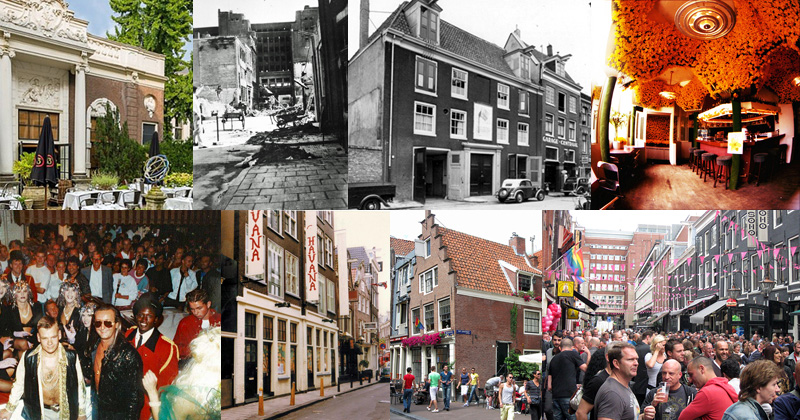
Separate articles tell the stories of some of the most famous former gay venues of Reguliersdwarsstreet:
And there's also more about some of the events in the street:
Here you can select the various periods in the history of Reguliersdwarsstraat:
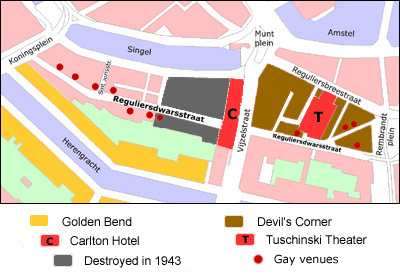
The important episodes of the history of the street are related to the areas marked on this map:
updated: 21-10-2021
Until 1586
Reguliersdwarsstraat has its name from a late mediaeval cloister of priests who lived according to the rule of Saint Augustine. Hence they were called regular canons (in Dutch: reguliere kanunniken). This cloister was build in 1394 and was situated not very far away from present-day Reguliersdwarsstraat. It was destroyed by fire in 1532.
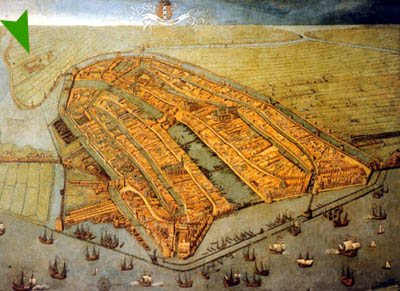
Birds-eye view of Amsterdam on a painting from 1538
In the upper left the former cloister of the regular canons
Later on, a few streets, a canal and a square were named after this cloister by the prefix Reguliers. Reguliersdwarsstraat is the street which lies more or less transverse (dwars) to the broad Reguliersbreestraat, which was the main street leading from the former Reguliers Square (now Rembrandt Square) to the old city centre.
1586 - 1800
Reguliersdwarsstraat itself was constructed in 1586, when a new fortification was build to protect the city. As walls couldn't resist canons anymore, the new fortifications consisted of an earthen rampart with bulwarks. These skirted the southside of Reguliersdwarsstraat, so at that time houses were only build along the northside:
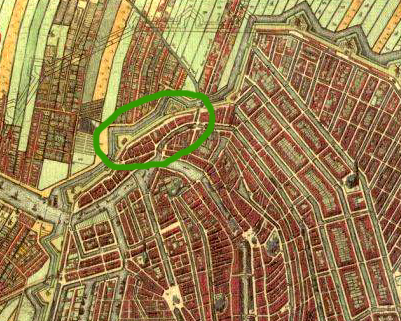
Detail of a map of Amsterdam from 1640 with
Reguliersdwarsstraat alongside the city wall
In 1664, the fortifications of 1586 were leveled in order to construct the new Herengracht. This canal was part of the large city expansion plan, which included the construction of the famous concentric canals (Dutch: grachtengordel).
The part of Herengracht right behind Reguliersdwarsstraat was called the Golden Bend (Gouden Bocht), because here the rich merchants and regents of Amsterdam built their big and stately houses:
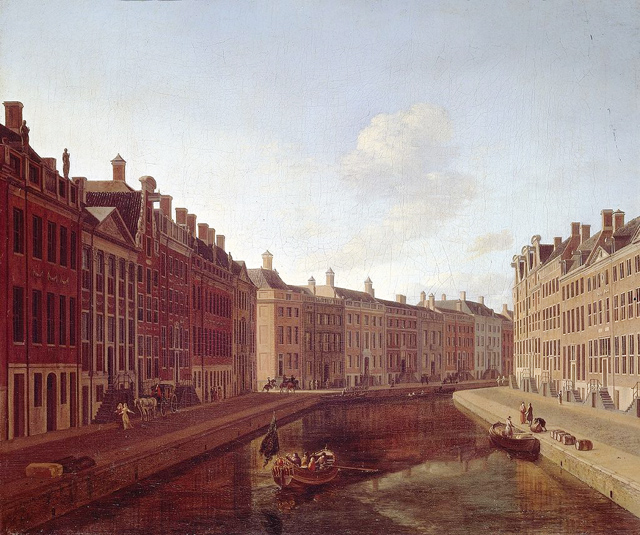
The Golden Bend of Herengracht, end of the 17th century
Painting by Gerrit Adriaensz Berckheyde
At the northside of Herengracht, these houses stood on lots reaching all the way to the southside of Reguliersdwarsstraat. This made it possible to have large gardens behind the big houses, with stables and coach-houses alongside Reguliersdwarsstraat. Nowadays there are still 19 of such coach-houses left, easily recognizable by the large front doors.
The back side of these coach houses, facing the garden, often has a decorated facade in the style of the main house. Nowadays, there are often fine restaurants in these coach houses, with the garden allowing superb and quiet terraces:
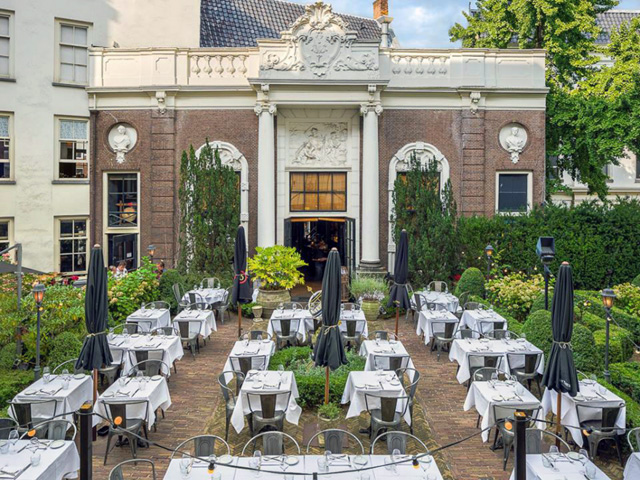
Garden terrace of restaurant-bar Lion Noir
(photo: Lion Noir)
1800 - 1945
Around 1800, most of the merchants and regents living at Herengracht lost much of their wealth, and the coach-houses were sold or rented to ordinary people. In the 19th century they were ideal for a variety of small business using horse carriages.
As the western part of Reguliersdwarsstraat was influenced by the wealth of the Golden Bend, the eastern part of the street was more influenced by the poverty of the back-street quarter called Devil's Corner (Duvelshoek).
In this neighbourhood there were countless small dwellings, a lot of small public houses and the streets were full of beggars, pedlars and all sorts of street performers.
At the beginning of the 20th century, a large part of Devil's Corner was pulled down, so the first cinemas of the Netherlands could be build there: in 1917 the Bioscope Theater of Franz Anton Nöggerath, and in 1921 the famous Tuschinski Theater, which is still one of the most beautiful Dutch cinemas.
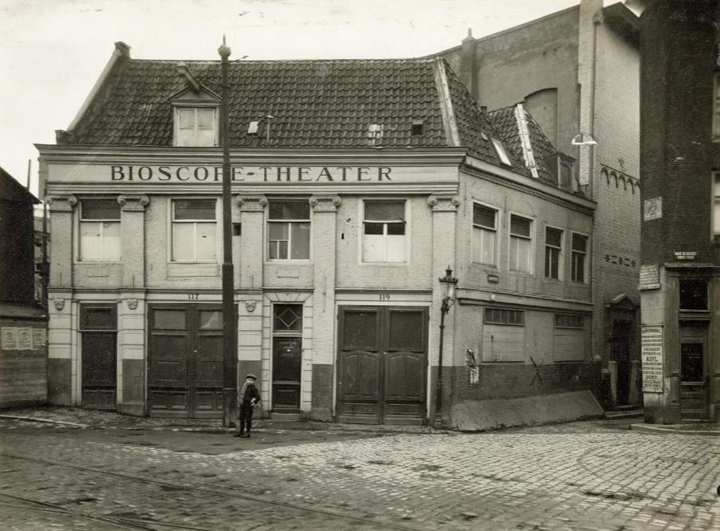
Old building, which was part of the
Bioscope Theater of F.A Nöggerath (1919)
(photo: Cornelis G. Leenheer/Stadsarchief Amsterdam)
At the same time, the then narrow Vijzelstraat was widened and the huge Carlton Hotel was build alongside it. This cut Reguliersdwarsstraat physically and visually in two parts. The hotel was so big, that it overarches the entrance to the western part of the street.
During World War II, German Nazi-officers were housed in the Carlton Hotel, which probably made it a target for the Allies. On the night of April 26, 1943, the Germans managed to shoot down a british Halifax bomber, which came down right behind the hotel:
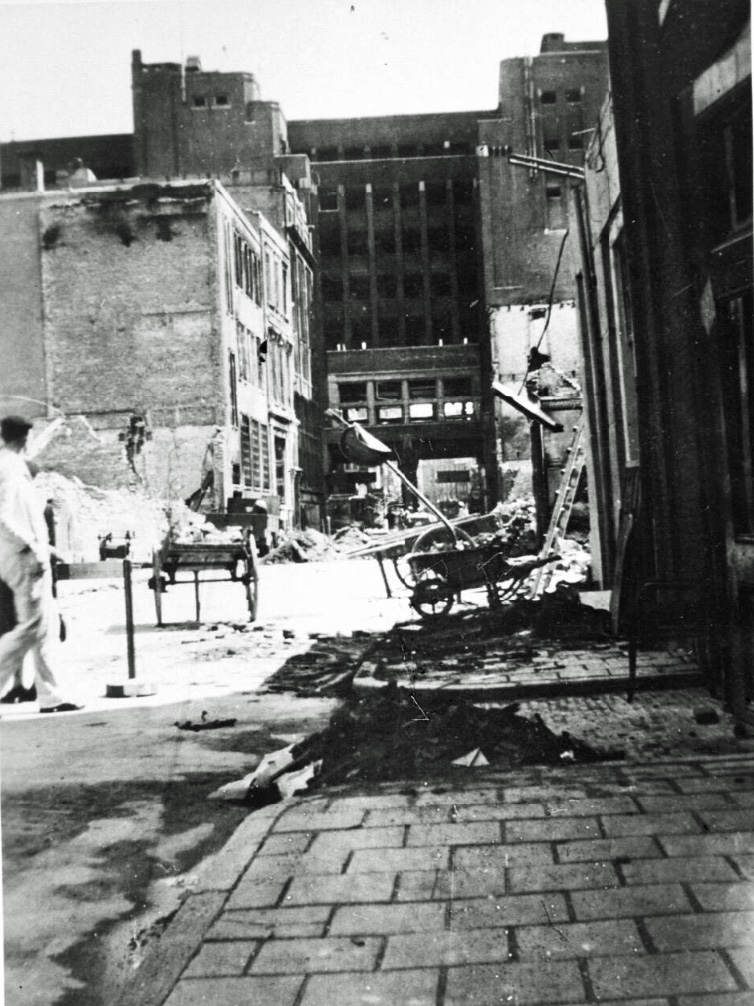
Not only the hotel was severely damaged, but the fire caused by the plane also destroyed all the houses in Reguliersdwarsstraat between the Carlton Hotel and Geelvinckssteeg. It was the most devastating fire that struck Amsterdam since 1659, but this time, as by a miracle, only 13 civilians died.
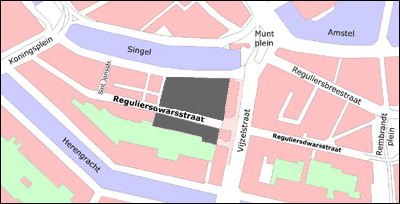
The part of Reguliersdwarsstraat that was destroyed in 1943
1945 - 1980
After the war, the area destroyed by the plane crash was used as a car parking for more than a decade. It wasn't until the sixties that big new buildings were run up here: Muntstaete for the city savings bank, and De Geelvinck and Munthof for offices and shops.
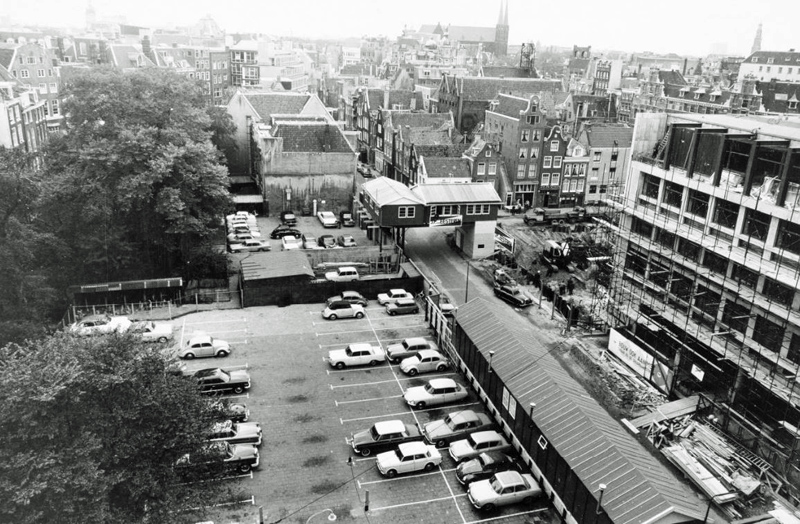
Car-park and construction activities in the area
which was destroyed during the was (1963)
(photo: Dienst Ruimtelijke Ordening/Stadsarchief Amsterdam)
Since the fifties there was a steady growth of bars and restaurants in Reguliersdwarsstraat. Ordinary straight bars have since long been in the street, especially around Devil's Corner. The first restaurant was probably Ognibeni at number 74, which existed from 1936 untill the seventies.
In 1963, the first gay bar was opened in the street: MacDonald at number 11. In those days, gay bars had curtains in front of the window and a doorman at the door to prevent suspicious people getting in. Nevertheless, MacDonald was always a very decent bar, which was often visited by gay guys under 21, who where not allowed into the famous nearby gay disco DOK at Singel nr. 460.
In Amsterdam there was a rather liberal climate, so already in 1970, the city got its first openly gay establishment: Coffeeshop Downtown. A this started as an espresso bar, it was called a coffeeshop, years before that term became associated with places where soft drugs are sold. Downtown existed for just over 50 years and closed in 2021.
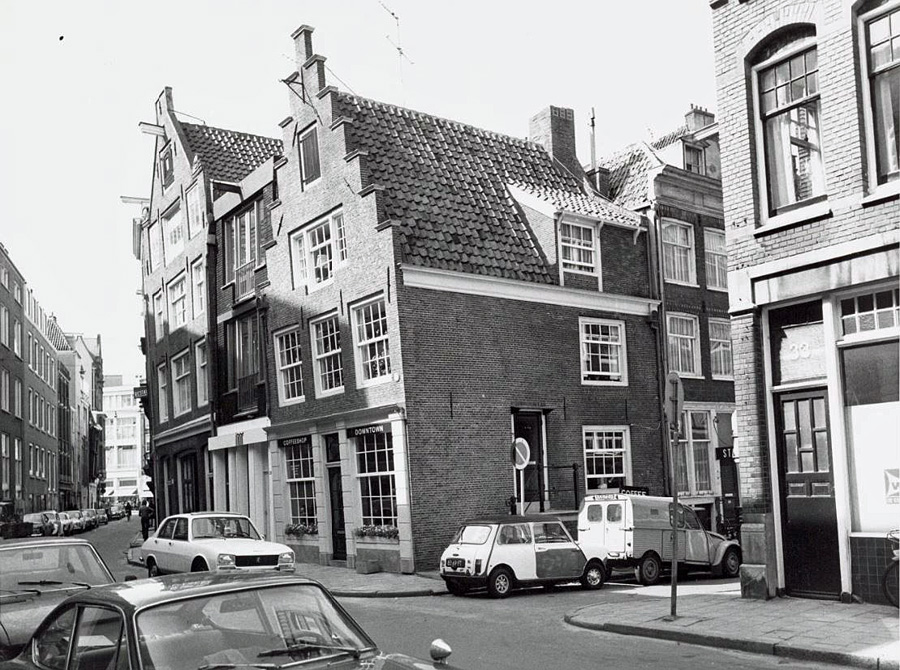
Coffeeshop Downtown in 1972
(photo: J.M. Arsath Ro'is - click to enlarge)
Six years later, the first gay disco opened in Reguliersdwarsstraat: De Viking at number 17-19. At first this was like a hippie place, but later on it got a bad name because of business boys, drug dealers and wild sex parties. De Viking was closed after a drugs raid by the police in 1987.
In the eastern part of Reguliersdwarsstraat, the number of bars had grown to eight in the 1960s, with some more in Korte Reguliersdwarsstraat. This were ordinary straight bars, but in the seventies and eighties some of them turned into gay bars for some years.
1980 - 2000
The eighties are known as the first golden decade of Reguliersdwarsstraat. Starting with the opening of the Mexican restaurant Rose's Cantina in 1980, more and more fine and foreign restaurants came into the street, some of them of the highest ranking and still existing today.
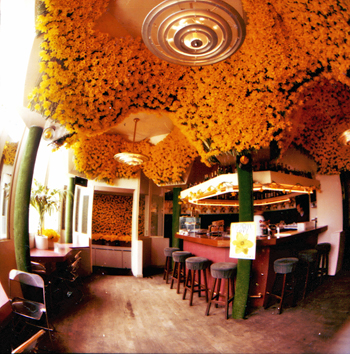
Gay cafe April decorated for an Easter party in 1982
(photo: collection Frans Monsma)
A year later, in 1981, Frans Monsma and Guus Silverentand opened the world-famous Café April. This was not only the first public gay bar that was open untill late night, it was also generally one of the most hip and trendy bars of those days.
Directly from the start April became famous for its big and fancy parties with spectacular decorations. Gay people from all over the world came here on their trip to Amsterdam. When this bar was extended and a rotating bar was installed in 1996, it was the biggest gay bar in Europe.
.jpg "A view alongside gay Cafe April in 1983")
A view alongside gay Cafe April in 1983
(photo: David Jarrett - click to enlarge)
> More pictures of Amsterdam gay businesses 1983-2010
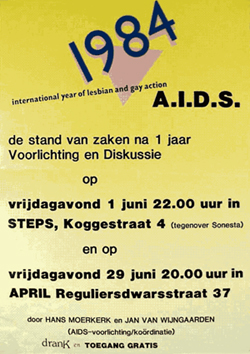
Until the mid-1980s, gay life and gay sex were largely without worries, but around 1983, AIDS reached Amsterdam too. Because very little was known about this deadly disease, the first information and prevention meetings about Aids were organized at April as of late 1983.
Since 1985, more and more gay men got infected, but they had little support for coping with their situation. To help them, the owner of the April, Frans Monsma, together with Pascal van den Noort and Alex van der Hoorn, initiated a fund that could pay for things that would make the life of patients more bearable.
In order to provide money for this fund, Frans Monsma also organized the very first aids benefit party, which took place in 1985 in disco Flora Palace. Many people disliked the idea of partying because of a disease, but in the end it was a succes: it made the issue less of a taboo and the money became the seed capital for the Dutch Aids Fonds.
(collection: IHLIA-Homodok)
In 1986, April and Downtown were taken over by bar tycoon Sjoerd Kooistra, who was expanding his business from Groningen in the far north of the Netherlands to Amsterdam. Here, he had bought his first bar one year earlier: the trendy straight bar Oblomow, which was at Reguliersdwarsstraat number 40.
Two years later, Kooistra opened gay disco April's Exit, but until 1996 these places were run by his compagnon Louis Röst. But after Kooistra took over the famous straight disco "36 op de schaal van Richter" in 1996, he got personally involved with his bars in Amsterdam. He turned Richter into the big gay pub Soho in 1999, making it one of his personal favourites.
The most famous night life venues from the 1980s and 1990s:
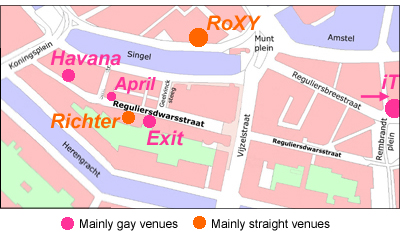
Meanwhile, Frans Monsma had opened yet another very successful place: Havana, which was a combination of a cafe and a dancing and attracted a mixed crowd of gays and trendy straight people. The opening of Havana in 1989 marked the start of the nineties, a decade in which Amsterdam night life became trendsetting worldwide.
Havana became famous for its fancy parties, which for example promoted the Eurovision Song Festival among gay people and made drag queen performances so popular that Nickie Nicole, who hosted these parties at Havana, even got a show on national televion.
The biggest parties however, were organized in cooperation with the world famous club iT in nearby Amstelstraat. These Hollywood Parties started at Havana and fanciful dressed-up visitors were brought to the iT by horse-carriages or limousines. They were truly the most splendid night life events of the year:
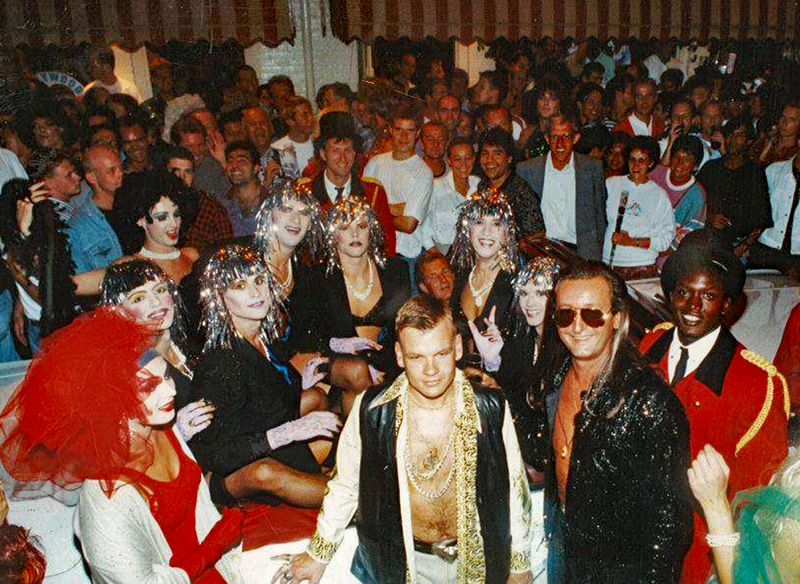
People gathering outside the Havana for a Hollywood-party
Photographer unknown - click to enlarge
Photographer unknown - click to enlarge
Havana also organized parties in cooperation with the exuberant straight disco RoXY, which had its own famous Gay Night on Wednesday - not less shockingly extravagant than the Gay Night Saturday's at the iT. All this made Havana, RoXY and iT the "Golden Triangle" of night life for both gay and straight people, who in those days partied together as never before.
In the eastern part of Reguliersdwarsstraat, the multicultural Reality Bar was opened in 1996, and by the end of 2006 't Leeuwtje was turned into a gay bar, bringing the gay community to the centre of this part of Reguliersdwarsstraat too.
Night life in general saw somewhat of a decline in the second half of the 1990s: the iT had already lost its very special vibe after the death of its owner Manfred Langer in 1994, while the RoXY eventually burnt down completely during the funeral of its founder Peter Giele in 1999.
Gay night life however suffered little under this and continued to be lively and vibrant. In order to prevent that the Amsterdam gay scene would loose its attractiveness, a group of people from the Havana came up with a new event: Amsterdam Pride.
This Amsterdam Gay Pride was held for the first time in 1996 and became especially famous for its unique boat parade, in which of course also boats from the big gay venues in Reguliersdwarsstraat participated.
> More about the History of the Amsterdam Gay Pride
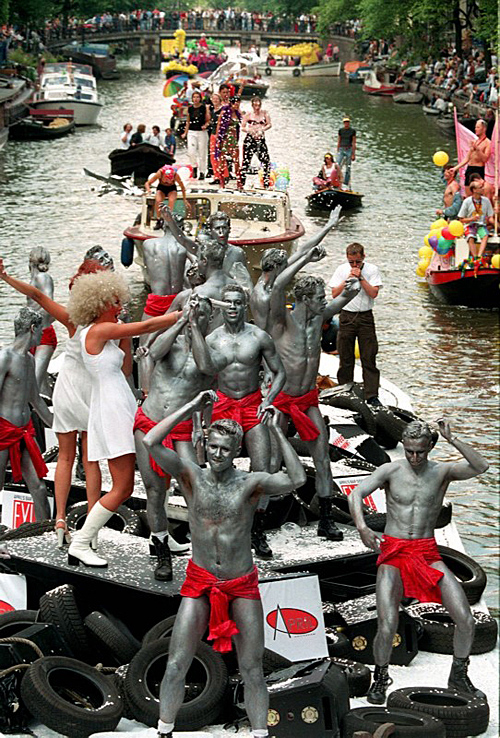
The boat of April and Exit in the Canal Parade
of the Amsterdam Pride in 1996
(ANP PHOTO/Hans Steinmeier - CC BY-NC-ND 4.0)
Two years later, the Canal Parade marked the opening of the Gay Games of 1998, which were held in Amsterdam. With over 14.000 athletes and some 250.000 visitors from around the world, this was the biggest gay event that had ever been held in the Netherlands. Besides the sporting contests, the event was also celebrated with parties in the gay streets, including Reguliersdwarsstraat.
> More about the Gay Games 1998
Amsterdam Pride and the Gay Games added to the self-confidence of the gay community and were new impulses for the gay night life scene, for which Reguliersdwarsstraat, with florishing venues like April, Exit and Havana, acted as the flagship. It culminated in what is remembered as the greatest open air street party of all: the performance of Kylie Minogue in Reguliersdwarsstraat during the Gay Pride of the year 2000:
dwarsstraat, during Gay Pride 2000
(video: MVS Gaystation)
2000 - 2010
In 2002, the popular gay dancing Havana was closed down by its owner, bar tycoon Sjoerd Kooistra. But in that same year Angelique Schippers and Rob de Jong opened a new place, which became the most trendy gay bar of that time: ARC.
The beginning of the 21th century was marked by the break-through of the internet. First this new medium was foremost used for publishing and gathering information: therefore since 1998 almost all restaurants, bars and clubs in Reguliersdwarsstraat made their own websites:
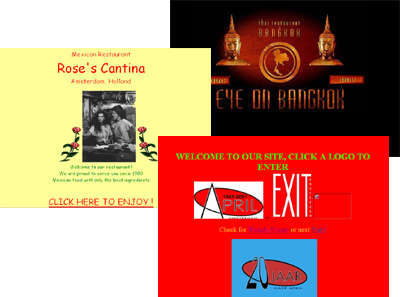
The first websites of restaurant Bangkok,
Rose's Cantina and April & Exit
A few years later more and more people got a permanent internet connection and this made it possible to use the world wide web also in an interactive way. Especially for a dispersed minority group like gays, this was a great opportunity to get in contact with eachother.
But that also meant there was less need to go to gay bars for finding friends. Through the internet one could search and find friends a lot more specifically. Together with price rises caused by the introduction of the euro in 2002 and gays people felt increasingly comfortable going out in straight establishments, the number of visitors of gay venues began to decline.
To make Reguliersdwarsstraat more attractive, the western part was reconstructed in 2006-2007: a new pavement was laid, old and disturbing objects were removed, sidewalks were made broader and, last but not least, the street can now be closed for cars during the summer season. This to make more space for pedestrians and terraces:
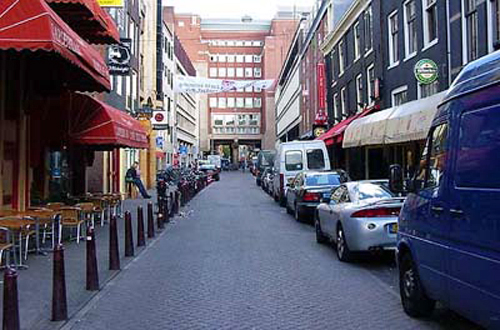
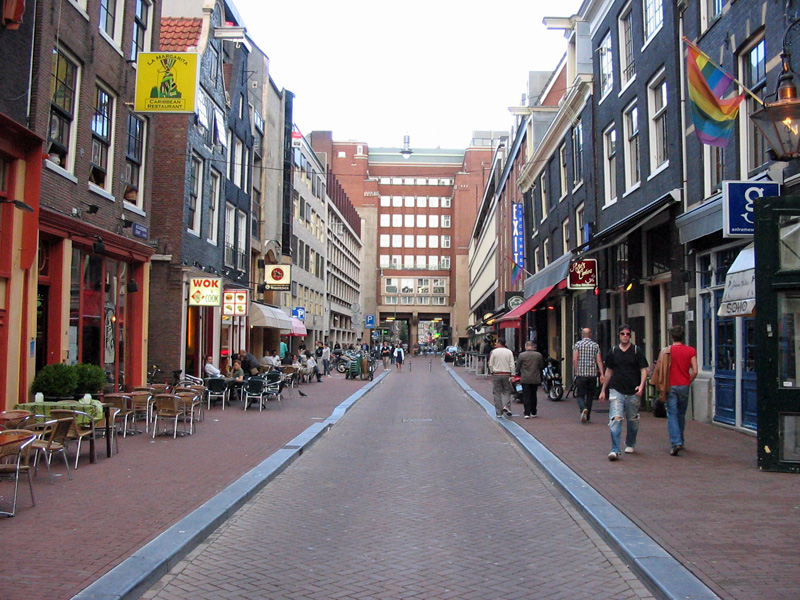
Reguliersdwarsstraat after reconstruction
By the end of 2007 bar-tycoon Sjoerd Kooistra, already owner of Downtown, April, Soho and Exit, bought gay bar ARC. That made him the sole owner of all big gay venues in the street. From this new position he announced things to improve security in the street and organizing bigger street parties.
In July 2009, Kooistra re-opened a completely renovated en refurbished cafe April, but by the end of that year he got some serious problems with the Heineken Brewery. They claimed the rent for his bars wasn't paid for almost a year and won a court case. With the court order Heineken closed Club Exit and the Exit Cafe on April 6th, and on May 19th even the world famous gay bar April.
Other breweries and companies also went to court to get paid, so even more bars of Sjoerd Kooistra closed their doors. One day before one of his favourite bars, gay pub Soho, had to be closed, the bar tycoon committed suicide at his estate near Nijmegen.
This unexpected and dramatic death of Kooistra was a great shock. Especially there was a great fear for the future of his venues in Reguliersdwarsstraat, as they were the flagship of the Amsterdam gay scene.
With so many visitors left without their favorite bars, a new gay bar called Taboo opened its doors in August 2010. But in september, the last big gay bars of late mr. Kooistra, ARC and Soho, were closed too. With only a few minor bars left, Reguliersdwarsstraat entered a long, cold and snowy winter...
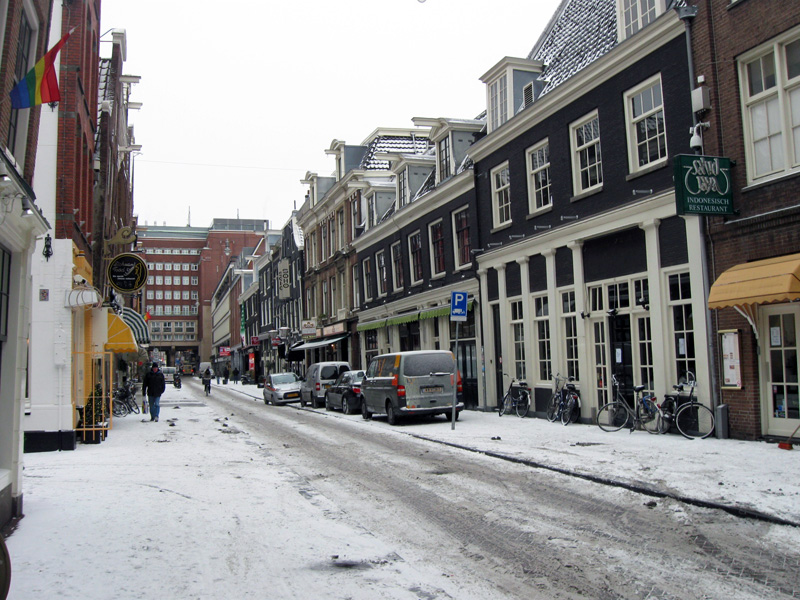
A cold and empty Reguliersdwarsstraat in December 2010
Even on the very last day of that disastrous year 2010, the legendary 40-year old gay lunchroom Downtown was closed too.
Since 2011
After the closures in 2010, many people definitely wanted "their street" and its gay venues back. Behind the scenes, the city government and the Heineken brewery also worked hard to find new owners for the bars.
Already in March 2011, gay Café Soho reopened, keeping its old name and its grand classic style interior. Next was the small Lunchroom Downtown, which opened its doors again on March 21. And on July 21, 2011 the mayor of Amsterdam himself came to Reguliersdwarsstraat for a grand reopening of the last three big gay bars:
- The legendary Café April was taken over by Casper Reinders, creator of some exclusive nightlife venues. He gave this place a completely new interior and also a new name: Ludwig II.
- Gay bar ARC got a new owner, who also restyled the interior and renamed the venue into EVE.
- Finally, also bar/club Havana, was reopened again, with the same name, but with a new interior.
- Gay bar ARC got a new owner, who also restyled the interior and renamed the venue into EVE.
- Finally, also bar/club Havana, was reopened again, with the same name, but with a new interior.
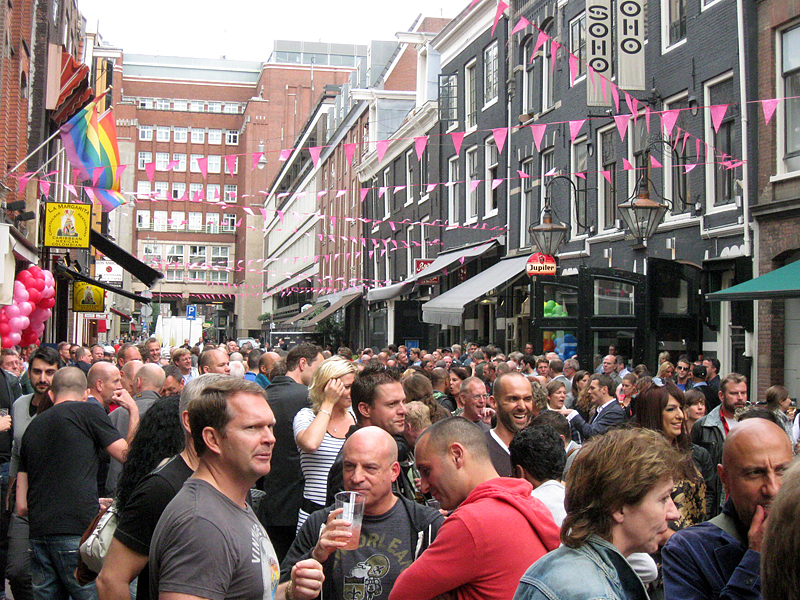
Street party for the reopening of the street on July 21, 2011
Unfortunately, none of these three new bars survived much longer than a year. Havana was already closed in January 2012, Ludwig II was turned into a straight underground bar and finally, also bar EVE was closed by the end of August 2012. They were either too exclusive, or the owner lacked experience in running a big bar.
New ratios
Somewhat surprisingly, the gay bars that did survive were those that had stayed the same: Soho and the Exit Cafe, and also Taboo bar, which was a new place, but continued the open atmosphere and the Happy Hour tradition of the April.
The closed gay places were ultimately replaced by straight bars, making that the share of gay visitors of the street went down from some 90% to around 50%. This gave many gay people the feeling that they "lost their street".
Also interesting is the case of the former gay disco Exit, which after an extensive renovation was reopened in October 2012 as club NYX. Initially, the new owner didn't want it to be a traditional gay club anymore, and focused on a crowd of trendy youngsters, regardless of their sexual orientation. It turned out that that didn't work well, so a clear division was made: now Saturday is gay night and Thursday is for straight students.
Secret Village
Although Reguliersdwarsstraat is still known all over the world as the main Amsterdam gay street, the newly created business association decided to re-brand and promote the western part of the street and its three side-alleys as "Secret Village".
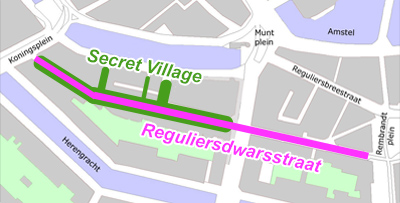
The Secret Village area in and around Reguliersdwarsstraat
The name Secret Village refers to the hidden 18th century gardens in which several restaurants have a great terrace, an atmosphere to be exported to the public side of the street too. For this, many plants, large and small, have been placed, also in order to make the street a showcase for greening cities in general.
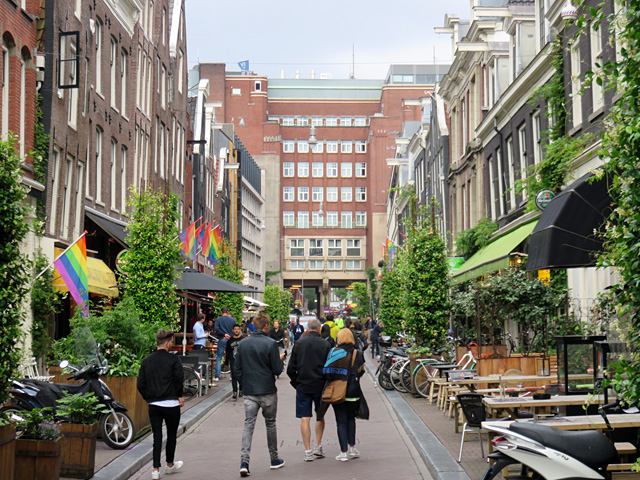
Lots of green in the Secret Village-part of the street
(click to enlarge)
Gay to stay
On June 9, 2016, Secret Village was officially opened with a street fair in which all the businesses presented their food and drinks. The big surprise however was a last-minute street party organized by club NYX, which in the evening unexpectedly attracted lots of gay people, making it feel almost like Gay Pride.
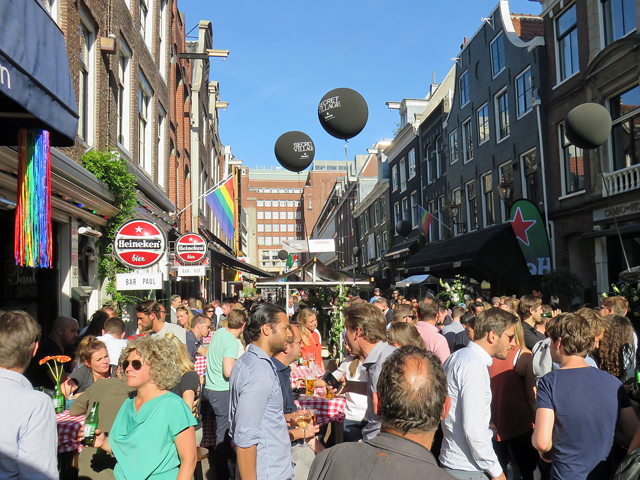
Grand opening of Secret Village in Reguliersdwarsstraat
(click to enlarge)
On June 12, 2016, just a few days after the opening of Secret Village, 49 visitors of gay club Pulse in Orlando, Florida, were killed in a shooting. This also shocked the gay community in Amsterdam and from club NYX in Reguliersdwarsstraat a candlelight vigil was organized at the gay monument on Westermarkt.
The Orlando attack renewed awareness for the still precarious situation of gay people and the need for places where they can go out safely. This, and the support that came up after the erroneous press report, reaffirmed the position of Reguliersdwarsstraat as the main Amsterdam gay street.

It's often said that Reguliersdwarsstraat isn't that gay anymore, but after the opening of Taboo Kantine early 2018 and Bar BLEND in 2019, there are now just as many gay venues in the street as during the heydays of the Kooistra-era.
What makes a difference though, is that nowadays all gay places are concentrated in the center part of the street, so at night, the rest of the street isn't very attractive for gay people. But during the day and the evening, the shops, hair salons and restaurants across the street attract many gays too.
Links
- Wikipedia-articles:
- History of Amsterdam
- LGBT history in the Netherlands
- About The Amsterdam Gay Bar Culture (until 1970)
- The story of photographer Christopher Regis-Gludd
- Articles in Gay News:
- Reguliersdwarsstraat effervescent as ever (2002)
- Mark Schröder about April, Soho and Exit (2003)
- Empire of catering Tycoon Kooistra Under Fire (2004)
- April Celebrates Twenty-fifth Anniversary! (2006)
- Kooistra loses court-cases, April and Exit need to close
- Dutch International Homo/Lesbian Information Center and Archives: www.ihlia.nl
- Compare San Francisco: There Goes the Gayborhood! (2007) - San Francisco's tech bros told: quit changing the gayborhood (2016)
... and London: Closing time: the loss of iconic gay venues is a nasty side-effect of London's sanitisation (2015)
- In a broader perspective: On the Closing of the Last Lesbian Bar in San Francisco: What the Demise of the Lex Tells Us About Gentrification
- See also: Dance music was born in LGBT communities, but has this been forgotten?
